Trails
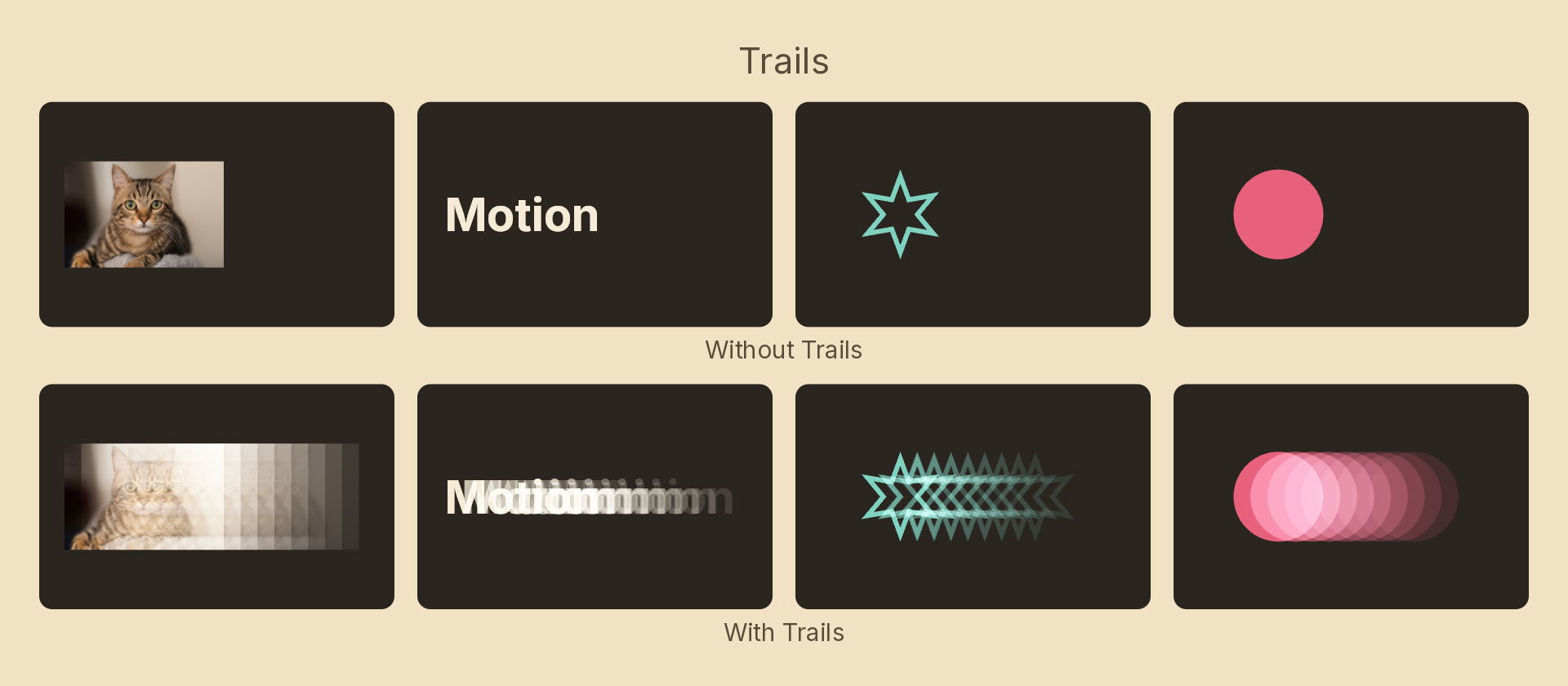
Echoes the node along its own motion — each tap delay seconds further back, faded by a decay factor.
The node-level counterpart of the video echo filter, sharing its vocabulary deliberately: same fields, same meaning, different scope. Where echo reaches back into a decoded video's own frames, this echoes what the node drew — so it trails text, shapes, a whole subtree, or a 3D view.
Usage
import { Effects } from 'motion-script';

// A short, tight trail
<Text text="FAST" effects={Effects.trails(6)} />

// Longer and more separated
<Ellipse effects={Effects.trails({ echoes: 12, delay: 1 / 15, decay: 0.85 })} />

// Ghosts behind rather than screened over
<Rect effects={Effects.trails({ echoes: 8, blend: 'normal' })} />
Only a node that moves shows a trail. A static node renders untouched rather than stacking copies of itself into a glow.
Props
| Prop | Type | Default | Description |
|---|---|---|---|
type | 'trails' | – | Effect identifier |
echoes | number | 6 | Echo taps drawn behind the node, capped at 16. 0 = off |
delay | number | 1 / 24 | How far back each successive tap reaches, in seconds |
decay | number | 0.72 | Per-tap alpha multiplier; tap n is drawn at decay ** n |
blend | BlendMode | 'screen' | How the taps composite. 'screen', 'add' and 'normal' are implemented; anything else falls back to 'screen' |
How it's derived
Trails are computed from the node's sampled velocity, exactly as motion blur is — not from a buffer of past frames. Each tap reconstructs where the node was by undoing delay × n of its motion (translation and rotation both).
That is what makes the effect a pure function of the playhead. Motion is sampled on every advanced frame rather than every rendered one, so a backward scrub lands on exactly the trail a forward play would — and a single-frame render (ms screenshot) shows the full trail rather than nothing. A frame-history implementation cannot do that: seeking replays the scene generator without drawing the frames it passes through, so there would be no history to rebuild from.
The trade is that a tap extrapolates along the current velocity rather than following the node's actual past path, so a trail spanning a sharp curve straightens out. Motion blur makes the same approximation across a single frame; here it spans echoes × delay, so keep the trail short relative to how fast the path turns.
Content that changes without moving — text retyping, a fill cross-fading — is echoed at its current appearance, not its past one.
Cost
Each tap is one extra sample of the node's content in the trail shader. There is no frame buffer and no per-tap texture, so cost scales with echoes alone and memory is unaffected.
Animating
echoes rounds rather than snapping, so a tween from 0 grows the trail instead of popping it in at the midpoint.
import { createScene, Ellipse, Effects, easeInOut } from 'motion-script';

export default createScene(function* (stage) {
  const dot = stage.add(<Ellipse width={80} height={80} fill="#6990DD" />);

  dot.set({ effects: Effects.trails({ echoes: 0 }) });
  yield* dot.to({ effects: Effects.trails({ echoes: 10, decay: 0.8 }) }, 0.5);
  yield* dot.moveX(600, 1.2, easeInOut('quad'));
});
See also
- Motion blur — smears continuously within a single frame's shutter, where this leaves discrete separated ghosts across a much longer span. Both read the same sampled velocity, so they stack cleanly