Duotone
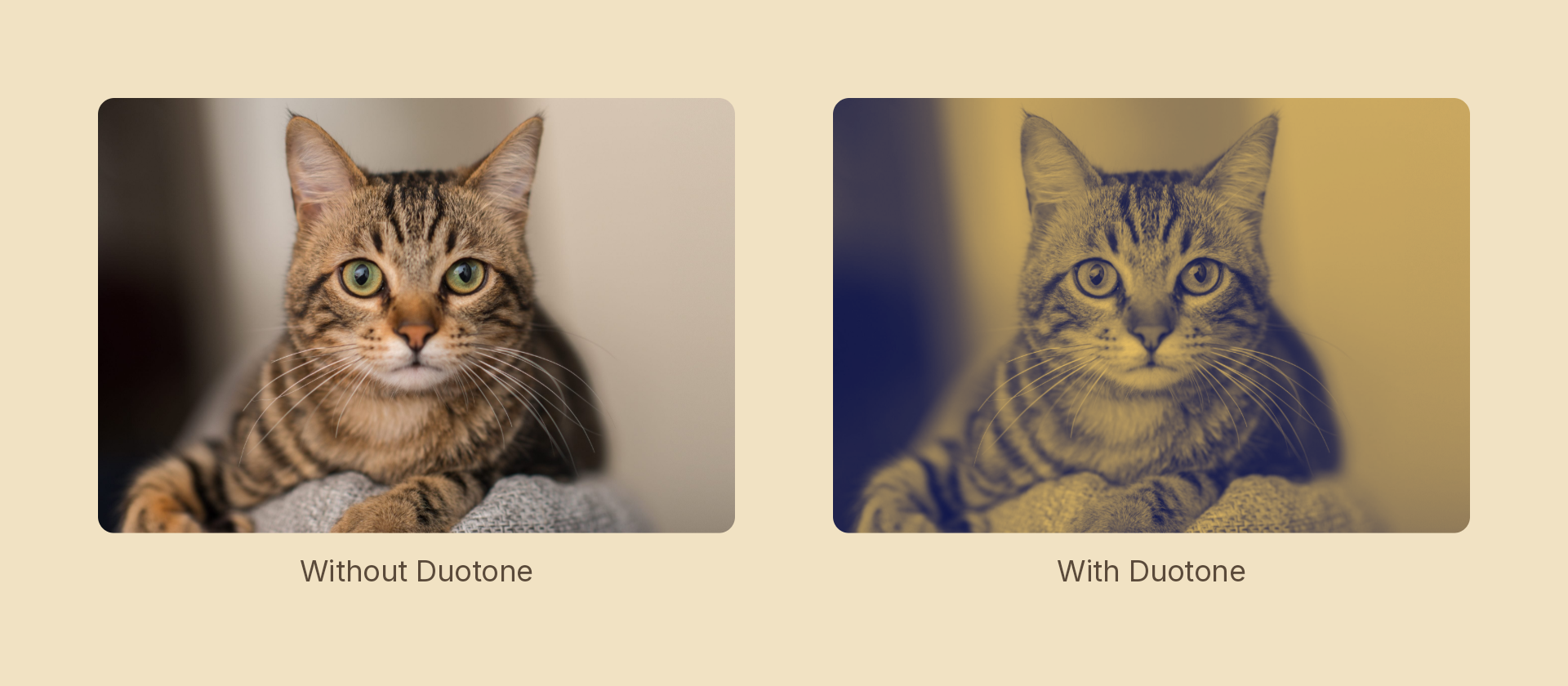
Remaps the content's luminance onto a two-color ramp: black becomes shadows, white becomes highlights, everything between interpolates. The source's own chroma is discarded — only its brightness survives.
Usage
import { Effects } from 'motion-script';

// Default: a full black→white ramp (i.e. luminance)
<Image src={'./photo.jpg'} effects={Effects.duotone()} />

// Scalar shorthand sets the blend amount
<Image src={'./photo.jpg'} effects={Effects.duotone(0.7)} />

// The editorial two-colour treatment
<Image src={'./photo.jpg'} effects={Effects.duotone({ shadows: '#12184a', highlights: '#ffd166' })} />

// Theme aliases work like anywhere else
<Rect effects={Effects.duotone({ shadows: 'bg', highlights: 'primary' })} />
Props
| Prop | Type | Default | Description |
|---|---|---|---|
type | 'duotone' | – | Effect identifier |
amount | number | 1 | 0–1 blend from the original colors to the full ramp |
shadows | Color | 'black' | Color the darkest tones map to |
highlights | Color | 'white' | Color the brightest tones map to |
mode | 'foreground' | 'backdrop' | 'foreground' | 'backdrop' maps the content beneath the node |
The ramp colors' alpha is ignored — they name the two ends of a tone scale, not translucent inks. Node alpha is untouched, so the silhouette survives the grade.
Animating
Both the ramp colors and amount interpolate, so you can cross-fade between palettes:
import { createScene, createRef, Image, Effects, easeInOut } from 'motion-script';

export default createScene(function* (stage) {
  const photo = createRef<Image>();
  stage.add(
    <Image ref={photo} src={'./photo.jpg'} effects={Effects.duotone({ shadows: '#12184a', highlights: '#ffd166' })} />,
  );

  yield* photo().to(
    { effects: Effects.duotone({ shadows: '#3a0a2a', highlights: '#00f5d4' }) },
    1.2,
    easeInOut('quad'),
  );
});
Stacking with other effects
// Riso: screen it, then ink it
<Image src={'./photo.jpg'} effects={Effects.halftone({ size: 6 }).duotone({ shadows: '#0033a0', highlights: '#ff4f7b' })} />
Duotone is affine in the source channels, so it composes as a plain color matrix alongside its neighbours in the chain — it costs no more than a grayscale.